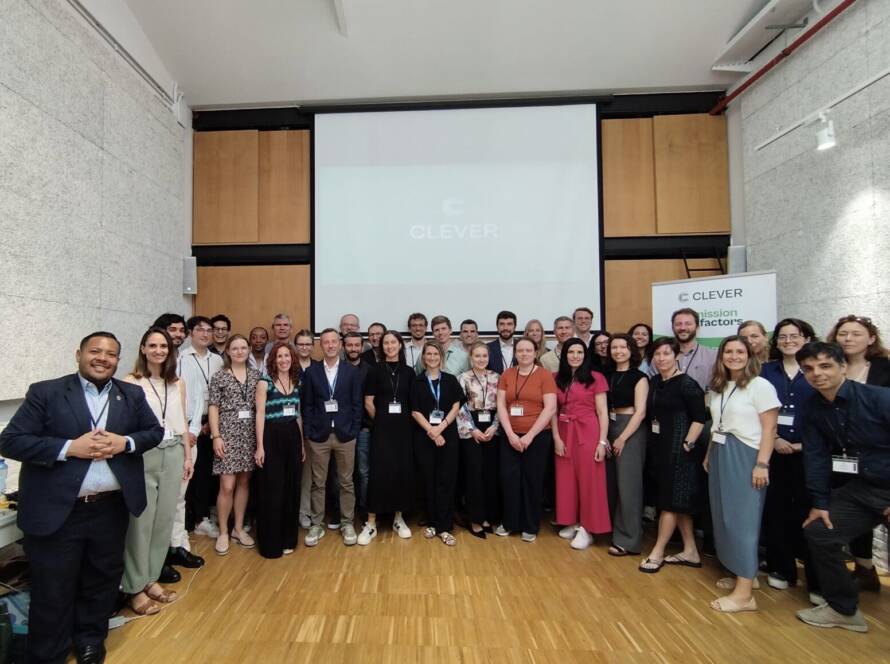
With all selected Use Cases now underway, initial insights highlight the importance of primary data availability, reliable information on fuel and energy types, and clear methodological assumptions for transport emissions accounting.
04 November 2026 – The EU-funded CLEVER project has initiated all 12 Use Cases selected through its Open Call, with activities now underway across both Wave 1 and Wave 2. As the project moves further into the practical application of its greenhouse gas (GHG) emission factor methodology, initial exchanges with participating organisations are highlighting important considerations for consistent and reliable transport emissions accounting.
The 12 Use Cases span different transport activities and four main areas: emission calculation, accounting and reporting, conformity assessment, and climate mitigation actions. Together, they provide opportunities to explore how the CLEVER methodology and emission factors can be applied across different operational settings.
From methodological development to real-world application
Through the ongoing Use Case activities, the CLEVER team has engaged with participating organisations to better understand their motivations, expectations and intended applications of the methodology.
These discussions have revealed considerable interest in the CLEVER methodology, particularly in how emission factors may be used within the context of the EU’s CountEmissionsEU initiative.
The 12 organisations selected through the CLEVER Open Call are:
- CMA CGM
- EMT Madrid
- Finnlines Plc
- Hamburger Hochbahn AG
- ISCC System GmbH
- Kinver TerraTwin
- Kuehne+Nagel
- Logistics in Wallonia
- Netherlands Enterprise Agency (RVO)
- Niinivirta Transport spa
- TRATON AB
- VTT Technical Research Centre of Finland Ltd
While some Use Cases focus primarily on the methodological development of emission factors, others explore their practical application in real-world transport and logistics operations. The activities also provide opportunities to examine different emission factor calculation approaches and certification schemes.
This combination of methodological and practical perspectives is helping the project identify the information and conditions needed to support consistent application across different scenarios.
Initial insights: data availability and methodological clarity
Although the Use Cases remain ongoing, the first exchanges have already highlighted three important considerations for the application of transport emission factors.
Data granularity and availability. The level of detail available in operational datasets plays an important role in applying emission factor methodologies. Access to primary data remains a challenge in certain contexts, making data availability an important consideration for participating organisations.
Fuel and energy data. Reliable information on fuel or energy used is essential for applying CLEVER emission factors correctly. Data derived directly from transport operations are particularly important for ensuring that calculations reflect the energy consumed.
Methodological boundaries and assumptions. Understanding the boundaries and assumptions used to derive emission factors is essential for meaningful comparisons between different calculation approaches and their results. Clearly defined methodological choices help organisations interpret emission factors consistently and understand how different approaches may affect their calculations.
These initial insights underline the importance of considering both methodological requirements and operational data availability when examining how harmonised emission factors can be applied in practice.
Bringing the discussion to the Smart Freight Fall Meeting 2026
The CLEVER project was also featured at the Smart Freight Centre Fall Meeting 2026, held from 20 to 22 October in Atlanta, United States.
The CLEVER session explored the challenges of comparing greenhouse gas emission factors calculated using different methodologies, highlighting how the same fuel can be associated with different emission factors depending on the approach used.
Discussions also addressed the importance of harmonised well-to-wheel methodologies and the role of primary data in supporting more consistent and transparent transport emissions accounting. These themes complement the initial insights emerging from CLEVER’s ongoing Use Case activities.
Next steps
As the Use Cases progress, CLEVER will continue working with participating organisations to explore the application of its emission factors and methodology across different transport activities.
Further exchanges and assessments will help the project build a clearer understanding of practical implementation requirements and contribute to the continued development and validation of harmonised approaches to transport emissions accounting.
The Use Cases are an important part of CLEVER’s wider efforts to support greater transparency, consistency and reliability in the calculation and reporting of transport-related GHG emissions.
About CLEVER
CLEVER is a Horizon Europe-funded research and innovation project working to improve the consistency, transparency and reliability of greenhouse gas emissions accounting in the transport sector. Through the development of harmonised emission factors and supporting methodologies, the project aims to provide a stronger basis for calculating and comparing transport emissions across different activities and operational contexts.